Showing posts with label Spy. Show all posts

Friday, April 11, 2008

Daily pill of Defence - 12 April 2008

CBI chargesheets former RAW officer
Yahoo News

The CBI on Wednesday filed a chargesheet against a former senior officer of the Research and Analysis Wing (RAW) for divulging "top secret" information in his book, which alleged corruption in country's external intelligence agency. Accusing both author Maj Gen (retd) V K Singh and publisher of the book - India's External Intelligence, Secrets of Raw - Vivek Garg, the CBI filed its chargesheet under two different sections of the Official Secret Act, 1923 in the court of Chief Metropolitan Magistrate here. (read more)
Indian Navy reaches North Pole
FIDSNS

The Indian Navy team has reached the geographic North Pole at 2016 Hrs (local time) on the night of 9th April 2008. Having created many a records in the past including the successful ascent of Mt. Everest in 2004 and ski traverse to the geographic South Pole in 2006, the team of ten officers and men of Indian Navy set out for a historic ski traverse to The North Pole at 90° North. The team reached North Pole yesterday night, thereby becoming the first ever Indian Team to have successfully ski traversed to both the geographic poles. Three of the ten members have also joined the elite club to successfully complete the “Three Poles” Challenge. (read more)
See Also: MoD Press Release - Times of India - The Statesman - The Telegraph - The Hindu -
French company attempted illegal export of sensitive technology to Iran
FIDSNS

Cryostar SAS, formerly known as Cryostar France (”CRYOSTAR”), a French corporation, headquartered in Hesingue, France, has pleaded guilty in a US court to conspiracy, illegal export, and attempted illegal export of cryogenic submersible pumps to Iran. (read more)
Fight for Sadr City a Proving Ground for Iraq Military
Michael R. Gordon, New York Times

The Iraqi soldiers pushed their way up a main thoroughfare in Sadr City over the past week, but the militias that still prowl the Shiite enclave were sniping at them from the alleyways. So a platoon of American troops drove up a bomb-cratered road in their Stryker vehicles on Thursday to give the Iraqis some pointers on how to hold the line.
...
The struggle for control of Sadr City is more than a test of wills with renegade Shiite militias. It has also become a testing ground for the Iraqi military, which has been thrust into the lead. (read more)
India to invite bids for purchase of 312 helicopters
The Hindu Business Line

Close on the heels of floating multi-billion dollar global tenders for buying long-range artillery guns, India plans to invite international bids for purchase of 312 light helicopters. The tenders for these helicopters, 197 for the army aviati on and another 115 for the air force, are to be floated in the next few days and are estimated to be worth over $2 billion. (read more)
See Also: Times of India - Economic Times - Zee News - Thaindian

Thursday, March 20, 2008

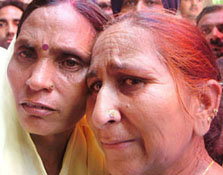
Sarabjit's wife: "I am against exchange of terrorists"

Image: Sukhpreet Kaur (l) and Sarabjit's sister, Dalbir Kaur (r)

Sarabjit Singh's case is probably the clearest case of government apathy and neglect. Why does the government always wake up at the last minute? And even when it does, it lacks the courage to take a strong stand.

Unlike the wife of Sarabjit Singh, whose statement below is probably the greatest display of patriotism that one has seen. Times of India has this report:

I am against exchange of terrorists: Sarabjit's wife
20 Mar 2008, 1211 hrs IST,TNN

NEW DELHI: Sarabjit Singh's wife Sukhpreet Kaur has opposed the idea of India freeing a hardcore terrorist in exchange of her husband's release.

Talking to TOI , she said: "My country must not release any terrorist in return of my husband." She was reacting to the speculation about the trading of Sarabjit with Afzal Guru, the mastermind behind Parliament attack. However, she said Pakistani nationals who had been languishing in Indian jails for mild offences could be released to secure her husband's freedom.

Denying that Sarabjit was a terrorist, she said that false cases had been registered against him.

(read more)


Its a pity our government has neglected these heroes. But what else can be expected from them.

Sunday, October 28, 2007

DRDO develops Micro-UAV

Here's a report from the Khaleej Times that caught my eye (Link1, Link2) about DRDO developing a new Micro-UAV:

DRDO develops tiny spy gadget
(IANS)
28 October 2007


AGRA — Indian scientists have developed a tiny gadget that can keep an eye on enemy territory and help in traffic management.

The details of the device were disclosed at the first national flying competition of Micro Aerial Vehicles (MICAV) at the Aerial Delivery Research and Development Establishment (ADRDE) of DRDO here.

Lt. Gen. V.J. Sundaram and Balraj Gupta of the DRDO, on Friday said the tiny unmanned device can remain in air for 15 to 20 minutes and send photographic data to computer networks. Soldiers on the borders can also use it to observe movements across enemy lines. Only 30 cm wide, the device looks like a bird to untrained eyes. It can survey an area of roughly one square kilometre from a height of 500 metres. It weighs about 400 gm and is powered by a rechargeable battery.

Sources said the actual production of the device could take as long as three years after a series of field trials and improvements from feedback were made available.

Agra will host an international MICAV competition in March 2008 in which teams from Japan, the US, France, Britain, Israel and some other countries are expected to participate. (Source)
One wonders why the Indian media haven't heard about this yet. Guess we'll be waiting for more information from DRDO.

Tuesday, October 16, 2007

Just so Stories- How Pakistan got its bomb

Here's a Guardian Report about how the US turned a blind eye to Pakistan's Nuclear activities, and even helped it along:

http://www.guardian.co.uk/pakistan/Story/0%2C%2C2188777%2C00.html

The man who knew too much

He was the CIA's expert on Pakistan's nuclear secrets, but Rich Barlow was thrown out and disgraced when he blew the whistle on a US cover-up. Now he's to have his day in court. Adrian Levy and Cathy Scott-Clark report

Saturday October 13, 2007
The Guardian


Rich Barlow idles outside his silver trailer on a remote campsite in Montana - itinerant and unemployed, with only his hunting dogs and a borrowed computer for company. He dips into a pouch of American Spirit tobacco to roll another cigarette. It is hard to imagine that he was once a covert operative at the CIA, the recognised, much lauded expert in the trade in Weapons of Mass Destruction (WMD).

He prepared briefs for Dick Cheney, when Cheney was at the Pentagon, for the upper echelons of the CIA and even for the Oval Office. But when he uncovered a political scandal - a conspiracy to enable a rogue nation to get the nuclear bomb - he found himself a marked man.

In the late 80s, in the course of tracking down smugglers of WMD components, Barlow uncovered reams of material that related to Pakistan. It was known the Islamic Republic had been covertly striving to acquire nuclear weapons since India's explosion of a device in 1974 and the prospect terrified the west - especially given the instability of a nation that had had three military coups in less than 30 years . Straddling deep ethnic, religious and political fault-lines, it was also a country regularly rocked by inter-communal violence. "Pakistan was the kind of place where technology could slip out of control," Barlow says.

He soon discovered, however, that senior officials in government were taking quite the opposite view: they were breaking US and international non-proliferation protocols to shelter Pakistan's ambitions and even sell it banned WMD technology. In the closing years of the cold war, Pakistan was considered to have great strategic importance. It provided Washington with a springboard into neighbouring Afghanistan - a route for passing US weapons and cash to the mujahideen, who were battling to oust the Soviet army that had invaded in 1979. Barlow says, "We had to buddy-up to regimes we didn't see eye-to-eye with, but I could not believe we would actually give Pakistan the bomb.

How could any US administration set such short-term gains against the long-term safety of the world?" Next he discovered that the Pentagon was preparing to sell Pakistan jet fighters that could be used to drop a nuclear bomb.

Barlow was relentless in exposing what he saw as US complicity, and in the end he was sacked and smeared as disloyal, mad, a drunk and a philanderer. If he had been listened to, many believe Pakistan might never have got its nuclear bomb; south Asia might not have been pitched into three near-nuclear conflagrations; and the nuclear weapons programmes of Iran, Libya and North Korea - which British and American intelligence now acknowledge were all secretly enabled by Pakistan - would never have got off the ground. "None of this need have happened," Robert Gallucci, special adviser on WMD to both Clinton and George W Bush, told us. "The vanquishing of Barlow and the erasing of his case kicked off a chain of events that led to all the nuclear-tinged stand-offs we face today. Pakistan is the number one threat to the world, and if it all goes off - a nuclear bomb in a US or European city- I'm sure we will find ourselves looking in Pakistan's direction."

US aid to Pakistan tapered off when the Soviet Union withdrew from Afghanistan. Dejected and impoverished, in 1987 Pakistan's ruling military responded by selling its nuclear hardware and know-how for cash, something that would have been obvious to all if the intelligence had been properly analysed. "But the George HW Bush administration was not looking at Pakistan," Barlow says. "It had new crises to deal with in the Persian Gulf where Saddam Hussein had invaded Kuwait."

As the first Gulf war came to an end with no regime change in Iraq, a group of neoconservatives led by Paul Wolfowitz, Dick Cheney, Lewis "Scooter" Libby and Donald Rumsfeld were already lobbying to finish what that campaign had started and dislodge Saddam. Even as the CIA amassed evidence showing that Pakistan, a state that sponsored Islamist terrorism and made its money by selling proscribed WMD technology, was the number one threat, they earmarked Iraq as the chief target.

When these neocons came to power in 2001, under President George W Bush, Pakistan was indemnified again, this time in return for signing up to the "war on terror". Condoleezza Rice backed the line, as did Rumsfeld, too. Pakistan, although suspected by all of them to be at the epicentre of global instability, was hailed as a friend. All energies were devoted to building up the case against Iraq.

It is only now, amid the recriminations about the war in Iraq and reassessments of where the real danger lies, that Barlow - the despised bringer of bad news about Pakistan - is finally to get a hearing. More than 20 years after this saga began, his case, filed on Capitol Hill, is coming to court later this month. His lawyers are seeking millions of dollars in compensation for Barlow as well as the reinstatement of his $80,000 a year government pension. Evidence will highlight what happened when ideologues took control of intelligence in three separate US administrations - those of Reagan, and of the two Bushes - and how a CIA analyst who would not give up his pursuit for the truth became a fall guy.

At first Barlow thought he was helping safeguard the world. "I just loved it," he says. His focus from the start was Pakistan, at the time suspected of clandestinely seeking nuclear weapons in a programme initiated by Zulfikar Ali Bhutto, the father of Benazir. "Everywhere I looked I kept coming up against intelligence about Pakistan's WMD programme," Barlow says. "I thought I was telling them what they needed to hear, but the White House seemed oblivious." Immersed in the minutiae of his investigations, he didn't appreciate the bigger picture: that Pakistan had, within days of Reagan's inauguration in 1981, gone from being an outcast nation that had outraged the west by hanging Bhutto to a major US ally in the proxy war in Afghanistan.

Within months Barlow was out of a job. A small band of Republican hawks, including Paul Wolfowitz, had convinced the president that America needed a new strategy against potential nuclear threats, since long-term policies such as détente and containment were not working. Reagan was urged to remilitarise, launch his Star Wars programme and neutralise ACDA. When the agency's staff was cut by one third, Barlow found himself out of Washington and stacking shelves in a food store in Connecticut, where he married his girlfriend, Cindy. He was not on hand in 1984 when intelligence reached the ACDA and the CIA that Pakistan had joined the nuclear club (the declared nuclear powers were Britain, France, the US, China and Russia) after China detonated a device on Pakistan's behalf.

Soon after, Barlow was re-employed to work as an analyst, specialising in Pakistan, at the Office of Scientific and Weapons Research (OSWR). The CIA was pursuing the Pakistan programme vigorously even though Reagan was turning a blind eye - indeed, Reagan's secretary of state, George Schultz, claimed in 1985: "We have full faith in [Pakistan's] assurance that they will not make the bomb."

Back on a government salary, Barlow, aged 31, moved to Virginia with his wife Cindy, also a CIA agent. From day one, he was given access to the most highly classified material. He learned about the workings of the vast grey global market in dual-use components - the tools and equipment that could be put to use in a nuclear weapons programme but that could also be ascribed to other domestic purposes, making the trade in them hard to spot or regulate. "There was tonnes of it and most of it was ending up in Islamabad," he says. "Pakistan had a vast network of procurers, operating all over the world." A secret nuclear facility near Islamabad, known as the Khan Research Laboratories, was being fitted out with components imported from Europe and America "under the wire". But the CIA obtained photographs. Floor plans. Bomb designs. Sensors picked up evidence of high levels of enriched uranium in the air and in the dust clinging to the lorries plying the road to the laboratories. Barlow was in his element.

However, burrowing through cables and files, he began to realise that the State Department had intelligence it was not sharing - in particular the identities of key Pakistani procurement agents, who were active in the US. Without this information, the US Commerce Department (which approved export licences) and US Customs (which enforced them) were hamstrung.

Barlow came to the conclusion that a small group of senior officials was physically aiding the Pakistan programme. "They were issuing scores of approvals for the Pakistan embassy in Washington to export hi-tech equipment that was critical for their nuclear bomb programme and that the US Commerce Department had refused to license," he says. Dismayed, he approached his boss at the CIA, Richard Kerr, the deputy director for intelligence, who summoned senior State Department officials to a meeting at CIA headquarters in Langley. Barlow recalls: "Kerr tried to do it as nicely as he could. He said he understood the State Department had to keep Pakistan on side - the State Department guaranteed it would stop working against us."

.....
.....
(read more)

Friday, June 15, 2007

Review- Our Man in Havana

Take James Bond, turn him on his head, add a daughter, add a bumbling M, and you get Our Man in Havana. This Classic by Graham Greene is an absolutely hilarious and irreverent look at the classical 'spy thriller' genre that so many have come to love.

Set in late 50s Cuba, at the end of the Batista regime and the beginning of the Cold War (with the MADness), this is the same setting that many other authors used as a setting for more adrenaline soaked stories. This one is different. It is the written equivalent of Dr. Strangelove.

Jim Wormold is a typical travelling englishman who's settled down into a happy blissfully ignorant existance in Havana. He's an almost-divorced vacuum cleaner salesman with a product that doesn't sell (whats the use of a vacuum cleaner in a time of irregular power), a very-catholic daughter who has grown to an expensive age and has a suitor who's the local Police Chief (a feared torturer with a cigar case of human skin). And, he's short on money. So, when he is accosted by a extra-secretive MI6 agent, Hawthorne, and offered money to become a spy, he goes against his inner instincts and accepts.

Not that he has any inclination or prowess at the job. What he does have, though, is a very fertile imagination. And this, he puts to great use, conjuring up agents (at the suggestion of his good friend and drinking partner, Dr. Hasselbacher)- a drunk, jobless pilot, a cabaret stripper with a mother to feed, the Doctor with the Mistress and others. Then, there is the secret base in the woods with very funny looking machines that everyone wants to know about. When London decides that Wormold is so good, he needs help, all hell breaks lose as Jim scrambles to clear the mess. Of course, wherever there is a secretary, there usually is a romance, and thats exactly what happens when Ms. Beatrice meets Wormold.

Till now, the plot is a classic comedy of errors. But Jim's imagination pulls him into murky territory when he passes off vacuum cleaner designs as secret military installations, and the competition starts taking Wormold too seriously. Fatal coincidences unravel into assassination, blackmail and betrayal. The reality of this murky underworld shocks Jim, who till then was blissfully happy fooling the MI6 and using the money to make his daughter happy. By the end of the book, there are no overt laughs, but black, grim humor in every word, as Jim tries to escape his situation and seek revenge at the same time. The ingenious checkers game with Captain Segura, the farcical poisoning scene, and Jim's ineffectual attempt to wreak vengence.


(Right: Wormold (
Alec Guiness) and Segura (Ernie Kovacs) play 'shot glass checkers' in a memorable scene from the 1959 Film)


The first half of the book is slightly slow, but has more laughs. The next part is sad, darkly humorous, and absurd, all at the same time. Overall, its a good mix of satire and black humor. Greene has wrung out all the absurdity and satire that epitomizes the Establishment and Spy World (at a time when most of them were Eton-educated Elites). It's a novel about a Secret Service thats eccentric, ridiculous and lethal. Hawthorne is the epitome of the Establishment - exclusive tie, stone-coloured suit and cold, stiff air. The Chief, removed from everyday realities by his literary imagination, is more concerned with trumping the Americans and Naval Intelligence than verifying his agents' reports.

The language is beautifully evocative. The characters are subdued, but memorable, as in all of Greene's works. Wormold is just trying to live a comfortable life to provide for his feisty daughter. Beatrice is the adventure-loving romantic, Captain Segura carries a perceptive cynicism along with his human skin cigarette case, and Dr. Hasselbacher, the most tragic and compelling of all the characters is a man much like Jim, of uncertain loyalties, sad and gentle, and a past he wanted to get away from.

To only treat Our Man... as a satire would be wrong. The Disturbing fact remains that the scenario described in the book can all too easily occur. Unfortunately, (as the story of Garbo below will show), the threat of faked and inaccurate intelligence is all too real (Iraq would prove this). The lessons for Intelligence is quite clear- verify, verify, verify. Our Man... has a deeper message behind its dark and cynical letters. One that is not lightly ignored.

I hope I haven't given much away. Either way, Our man in Havana is a light but engaging read that has become a classic for readers of satire. If you're one of those who can't sit for too long before a book, this one makes a good introduction to Greene's work, which are more serious, but equally good.

Interestingly, Greene based this book on his experiences as a spy for MI6 during WW2 (As his contemporary, Ian Fleming did as well, with his James Bond series). As they needed more trained spies, someone came up with the idea of training intellectuals, a decision which they regretted (apparently, MI6 decided never to recruit thinkers after the experience with Greene). Trained in using Radio, codes, secret writing (including the 'bird shit'), Greene found the whole experience boring and skull-drudgery. Of course, his travels in Africa (Attempting to run agents into the Vichy colonies from Sierra Leone) and Cuba allowed him to gather some intelligence and a whole lot of writing material (The Power and The Glory).

Garbo: The real Wormold

Another side-story that inspired Greene was that of "Garbo" (Juan Puyol Garcia), who tricked the Abwehr by providing fake (but seemingly credible) information that, like Wormold, was completely invented. He was instrumental in convincing Hitler that the Normandy attack was a feint for an actual one at Pas-de-Calais. The story of Garbo is almost as incredible as Wormold's; and the more one reads about him, the uncanny similarities all fall in place. (Read more at this BBC story)

A Nazi-hating Spaniard, Garcia originally offered his services to the British, who repeatedly turned him down. He next went to the Germans, and offered his services as a double agent. Garbo then set to work, inventing details, intelligence, and even agents- 27 in all. A drunken RAF officer in Glasgow and a Communist-hating War Office linguist were amongst the characters the Spaniard invented (uncannily like the drunk Pilot Raul from the book). His other stories included the existence of a massive arms dump under Chislehurst in south-east London, which the Germans even planned to blow up (again, uncannily similar to Wormold). When a particularly audacious attack was not predicted by him, he explained it off as his agent being ill, and hence, unable to gather intelligence. All this, with only a shipping table, A map of England, and a glossary of Military terms.

Ultimately, his usefulness brought back the British in 1942, who put him into their legendary double cross system. From then on, he fed the Germans with low level intelligence, mixed with his ingenious embellishments. Most of his informations, the Germans would learn any way; but since he would tell them first, it improved his standing dramatically. The Abwehr even revealed some of its spies under him (of course, they would be removed quickly by the MI6). The Abwehr never even suspected him. Indeed,
he was so convincing that the Nazis even awarded him the Iron Cross, with direct approval from Hitler himself (Since only Combatants could recieve the Iron Cross). Puyol became the only person to receive both the MBE and the Iron Cross as well. His amazing story was finally released after 50 years, in 1999. And what a story it is!