Showing posts with label MoD. Show all posts

Sunday, July 20, 2008

Sick and Tired

Aah, the Arjun fiasco continues. One lacks the patience or endurance to care any more about what happens next. Even if the Army does accept the tank, it will do so grudgingly, defeating the whole purpose of inducting a cutting edge tank. The Arjun has given the Army a perfect opportunity to usher in a Revolutionary in Military Affairs (RMA) , and create a new operational doctrine for their armored Corps who have till now been working with old, Soviet Era tactics.

But it appears that with the T-Series, the Army is following the "Familiarity breeds contentment" logic. Look at the most vehement and mindless opposition to any opinions or directives to conduct an impartial evaluation of the Arjun.

Things will not change till new minds inhabit Sena Bhavan. Till that day comes, I can only wait and watch and gnash my teeth at the destruction of our indigenous technology and a potent weapon. We can only hope that DRDO doesn't feel the same and comes back with a vengeance with a far better Mk.2 tank that the Army cannot ignore.

Tuesday, June 10, 2008

Adm. Arun Prakash about the 6th Pay Commission

Shiv Aroor has posted an excellent piece by Adm. (retd.) Arun Prakash about the 6th Pay commission on his blog, LIVEFIST. It is an excellent analysis and a definite must read.

Check it out at http://livefist.blogspot.com/2008/06/exclusive-reflection-by-admiral-arun.html

Wednesday, April 23, 2008

Paying for security

This isn't a post with my opinions in it; just a couple of news reports that I found very interesting. Unfortunately for our Armed Forces, this year hasn't been a good one for them, personally that is. After getting peanuts from the Budget (where else do you think Chidu-burr-rum, our educated and erudite, but ultimately spineless Finance Minister got the money for his sops to buy votes next year?), they've been screwed over by the Pay Commission.

The Armed Forces, after years of silent forbearing, finally decided that enough was enough - the men, at least. Thankfully, the Government, alarmed by the 200 high grade officers who put in their papers, decided to take a look and placate them. The Defence budget though, was somewhat forgotten...

In all the hoopla about the budget, most channels only had time to say that the defence budget had been hiked. What they conveniently forgot to mention was that overall percentage-wise, the budget actually fell, and alarmingly, to less than 2% of GDP. India should ideally spend around 3% of GDP on defence. This is a truly terrifying prospect when we consider that China is spending three times our own spending on its forces; and combined with its clamour over Tawang, the hard-nosed rhetoric from Beijing and its expanding tentacles across our Sphere of influence, it should have woken up the government to the threat that's been knocking on our door for some time now. Unfortunately, the sloth over essential defence deals seems to suggest otherwise.

Now, finally, the MPs have taken up the issue in parliament:
http://www.zeenews.com/articles.asp?aid=438237&sid=NAT


MPs want defence spending to match buildup by Pak, China

Concerned over the "sharp decline" in India's air and naval assets, members in Lok Sabha on Tuesday demanded a hike in defence spending to match the military build up by China and Pakistan. This was for the first time in more than 10 years that Lok Sabha took up for voting the Demands for Grants of the Defence Ministry which were earlier guillotined along with most of the Demands for Grants.

Participating in the discussion, members made a strong pitch for hiking India's defence spending in GDP terms to speed up acquisitions and modernisation of the armed forces. They said though India's defence spending had been considerably increased, the country had yet not been able to bring its air and naval power to the authorised level.

"This is a matter of grave concern," T P S Rawat, a retired Lt Gen and a new BJP member, said initiating the debate and demanded that the military expenditure be sustained at three per cent of the GDP for some years to enable India to equip its forces with advanced weapons systems and platforms.

Pointing out that in 2004-05 the defence budget was 2.41 per cent of the GDP, while for the current fiscal it was just 1.99 per cent of the GDP, Rawat said such a trend would have adverse impact on defence preparedness of the country.

He said government should bear in mind the budgetary allocations of Pakistan (3.5 per cent of GDP) and China (4.3 per cent of GDP) which are developing nuclear arsenal and anti-missile technologies, a potential threat to the country.

Lets hope that the Government actually takes their advice. There are far too many critical requirements that are being strangled by red-tape and corruption. I'm scared, I admit. Scared at the prospect that we may actually end up losing a war to Pakistan. And I'm sorry to say, if we do have a war within the next 3-4 years, there isn't really much we have to win it with. General Malik's quote, "We'll fight with what we have", will be the only thing that our Generals will have to say then; except that we won't be fighting men on mountaintops with only assault rifles and stingers.

1. Helicopters - The Helicopter deal, which is meant to replace the old Chetaks, and is essential for heliborne operations and transport of supplies. Apart from being essential to keep our Jawans in Siachen and other areas well supplied, in times of war, Military Utility Helicopters play a critical role in quickly moving troops and supplies to areas where they are needed most, moving the wounded out, and acting as critical elements in any high intensity, high mobility warfare.

2. Artillery - Artillery isn't the flashiest element in any operation, but its the most important. The Gulf War wasn't won by Tanks. It was won by Artillery. Kargil was won by the Bofors; the 1967 Nathu-La attacks by the Chinese were beaten back by our strong artillery. The problem is, we only have 350 155 mm guns left. So if there is indeed a war, we won't have anything to stop the enemy; our troops will not get critical fire support. In short, we'll lose. As for wheeled and Self Propelled Artillery pieces, the less said, the better.

Of course, this doesn't really concern our Soniaji, who is more worried about her Munna and her reputation rather than the lives of our Jawans. I can only pray that the next government actually cares.

3. Aircraft - The Chief of Air Staff, ACM Major has warned us that at this rate, our IAF will end up worse than the PAF. This is something that everyone should heed, not ignore as a Cassandra warning. Even when we were strong, Pakistan never hesitated to attack at the smallest sign of weakness. Imagine if we're weaker than them. What if an Islamist government comes to power in Islamabad? We need aircraft, and fast - the 126 aircraft MRCA has taken too long already. Right now, nothing short of a whipping is needed to get our procurement machinery on its wheels.

As for pay, its disgusting that we don't even care for our soldiers who willingly lay down their lives for our safety and prosperity. Forget honoring them, we don't even care to pay them well... And they have most justifiably complained. It is a testament to their dedication and values that they haven't revolted. But having heard their complaints and woes, its only a matter of time before they quit in disgust or throw down their weapons.

And its not only our soldiers, but our scientists as well. The Week has this report:

Brain damage
Strategic scientists feel short-changed by Pay Commission
By R. Prasannan

It was meant to be a cure-all pill. But the Sixth Pay Commission seems to have hit the brain badly. The country's space, atomic and defence scientists-who have launched satellites, are sending a moon probe, building missiles, rockets, warships and tanks-are the most disappointed lot. Worse still, they feel that the Pay Commission's recommendations would render their advanced labs into training ground for foreign companies.

As it is, the strategic science departments have a high attrition rate. Around one-sixteenth of those who join are leaving the Defence Research and Development Organisation (DRDO), which has 41 labs dealing with globally-denied missile science to cutting edge-technologies in food preservation. Atomic energy has a sanctioned strength of 35,519 posts, but only 32,855 personnel. The Department of Space is supposed to have 17,386 personnel, but is making do with 14,058.

Scientists feel that the pay panel has given them little more than this lip-service. "There had been proposals to offer incentives to strategic scientists. But I don't see anything of that kind. I think we have missed another opportunity," said Dr Amitav Mallik, former DRDO scientist and member of the National Security Advisory Board.

Scientists had suggested that they be paid one per cent of the contract value of technologies transferred to the industry. This has been rejected. No luck also for a demand for incentives for publishing scientific papers, or for a paltry Rs 20,000-price for filing a patent. Interestingly, the Council of Scientific and Industrial Research shares with its own scientists 60 per cent of the royalty received from technologies transferred to industries. A similar demand by strategic scientists has been rejected.

To prevent intellectual stagnation, scientists had demanded that the bright ones among them be encouraged to go on sabbaticals, as university teachers are. The commission rejected this and instead recommended contract appointments to bring about flexibility between government and private sectors. Even a demand for adjunct appointments, as visiting professors in universities, has been turned down.

Scientists point out that very few of their demands have actually been for money. The perks they were asking for were aimed at intellectual advancement, and a more academic career life. "Most demands, on the other hand, were for enhancing the quality of scientific talent available to strategic science laboratories. But the commission seems to have looked at them merely from an accountant's point of view," said an Ahmedabad-based space scientist.

Scientists are peeved that they continue to be treated like administrative personnel. Like the armed forces who have got their special status recognised through a military service pay, they had asked for an intellectual capital pay. This could be effected by amalgamating the three strategic science departments into an India Technical Service with different pay scales and perks. The demands have not even been discussed, though the commission pays lip-service to "the pre-eminent status" of the three strategic scientific services with a separate chapter on them.

Scientists point out that since their promotion system is merit and performance-based, their salaries should reflect the intellectual effort they have to put in. "At higher levels, promotions take place after evaluation by scientists from outside the departments. Since the scrutiny and evaluation is stricter, their work also demands better remuneration," said Dr A. Gopalakrishnan, former chairman of the Atomic Energy Regulatory Board.

Even a demand for a hazard allowance for those working on explosives (given to ordnance factory workers) has been turned down. Instead the commission said they could be given insurance, which scientists consider as blood money. Similarly, armed forces personnel deputed to posts like Leh in Ladakh get a high altitude allowance, but defence scientists working along with them in the same field research laboratory don't. "We also go on submarines, work on risky airborne experiments, and conduct field trials in deserts," said a DRDO scientist. He recalled the crash of the experimental Aerial Surveillance Platform 10 years ago in which half a dozen scientists, who were fitting a rodome on an experimental aircraft, died. "If test pilots are given an allowance for flying unproven aircraft, why can't we be extended the same allowance?" he asked.

Many of the younger scientists even suspect that the recommendations have been tailored to suit the interests of multinational R&D companies. "There are not even half a dozen companies in the world who can build jet engines," said a scientist at the Centre for Airborne Systems, Bangalore. "I have been working here for 15 years for the sheer pleasure of being part of a team that develops systems that you won't get even in Europe. I have spurned offers from Lockheed Martin and British Aerospace. I bought my first Maruti three years back. Even a receptionist in those companies drives better cars." Lockheed Martin may get him this year; next year he may be driving a Mercedes. (read more)

And you wonder why DRDO struggles so much?

Friday, April 11, 2008

Daily pill of Defence - 12 April 2008

CBI chargesheets former RAW officer
Yahoo News

The CBI on Wednesday filed a chargesheet against a former senior officer of the Research and Analysis Wing (RAW) for divulging "top secret" information in his book, which alleged corruption in country's external intelligence agency. Accusing both author Maj Gen (retd) V K Singh and publisher of the book - India's External Intelligence, Secrets of Raw - Vivek Garg, the CBI filed its chargesheet under two different sections of the Official Secret Act, 1923 in the court of Chief Metropolitan Magistrate here. (read more)
Indian Navy reaches North Pole
FIDSNS

The Indian Navy team has reached the geographic North Pole at 2016 Hrs (local time) on the night of 9th April 2008. Having created many a records in the past including the successful ascent of Mt. Everest in 2004 and ski traverse to the geographic South Pole in 2006, the team of ten officers and men of Indian Navy set out for a historic ski traverse to The North Pole at 90° North. The team reached North Pole yesterday night, thereby becoming the first ever Indian Team to have successfully ski traversed to both the geographic poles. Three of the ten members have also joined the elite club to successfully complete the “Three Poles” Challenge. (read more)
See Also: MoD Press Release - Times of India - The Statesman - The Telegraph - The Hindu -
French company attempted illegal export of sensitive technology to Iran
FIDSNS

Cryostar SAS, formerly known as Cryostar France (”CRYOSTAR”), a French corporation, headquartered in Hesingue, France, has pleaded guilty in a US court to conspiracy, illegal export, and attempted illegal export of cryogenic submersible pumps to Iran. (read more)
Fight for Sadr City a Proving Ground for Iraq Military
Michael R. Gordon, New York Times

The Iraqi soldiers pushed their way up a main thoroughfare in Sadr City over the past week, but the militias that still prowl the Shiite enclave were sniping at them from the alleyways. So a platoon of American troops drove up a bomb-cratered road in their Stryker vehicles on Thursday to give the Iraqis some pointers on how to hold the line.
...
The struggle for control of Sadr City is more than a test of wills with renegade Shiite militias. It has also become a testing ground for the Iraqi military, which has been thrust into the lead. (read more)
India to invite bids for purchase of 312 helicopters
The Hindu Business Line

Close on the heels of floating multi-billion dollar global tenders for buying long-range artillery guns, India plans to invite international bids for purchase of 312 light helicopters. The tenders for these helicopters, 197 for the army aviati on and another 115 for the air force, are to be floated in the next few days and are estimated to be worth over $2 billion. (read more)
See Also: Times of India - Economic Times - Zee News - Thaindian

Monday, April 7, 2008

Daily pill of Defence - 8 April 2008

Chandipur test site to get a facelift
ToI

India's ballistic missile and weapons testing facility in Orissa's Chandipur is being expanded to thrice its present size and modernised to test indigenously-developed weapons for India's defence forces. (read more)
Army gets first Muslim Major General from Kashmir
M. Saleem Pandit,ToI

Ever since Jammu & Kashmir became part of India, there has never been a Kashmiri Muslim general in the Army. This has now been remedied. With the elevation of Brigadier Mohammad Amin Naik to the post of Major General, Kashmiris, who have historically felt alienated from the mainstream, would now have one grievance less. (read more)
China using Sikkim to push Arunachal claim?
Rajat Pandit, ToI

China continues to play cat and mouse game in the eastern Himalayas despite having implicitly accepted Sikkim to be a part of India as a quid pro quo for New Delhi's unequivocal recognition of Beijing's claim over Tibet. There have already been already as many as 40 "intrusions" by Chinese troops across the 206-km border between Sikkim and Tibet since January this year, say top sources. (read more)
A.K. Antony visits Tawang
MoD Press Release

The Defence Minister Shri AK Antony has said ‘infrastructure development in the North East is now a top priority for the Government’. Addressing jawans on his maiden visit to Tawang today, Shri Antony said infrastructure development in the North East will not only contribute to the security of the nation but also accelerate the growth process of this vital region. (read more)
Sri Lanka Minister killed in suicide blast
The Hindu

A powerful Sri Lankan Minister was on Sunday assassinated by suspected LTTE rebels in a suicide attack on a marathon opening that also killed a former Olympian and 12 others while injuring nearly 100, in a bloody start to the strife-torn country's traditional New Year. (read more)
Gates: U.S. May Send More Troops to Afghanistan in 2009
FIDSNS

The United States may send more troops to Afghanistan in 2009, Defense Secretary Robert M. Gates confirmed on April 4. President Bush said during the NATO summit conference that ended today (April 4) that he expects the United States would make a significant additional contribution to the Afghanistan mission next year, Gates said. (read more)

Tuesday, March 25, 2008

30 Fighter jets crashed in past 4 years

The Ministry of Defence released the details of fighter crashes over the past 4 years, from 2004 to 2008.

The numbers are not nice to see... almost 2 squadrons lost over the past four years. This, not counting losses of helicopters or other aircraft. 2004-2005 seems to have been the worst year, with 11 crashes, followed by 2006-07.

More concerning is the loss of relatively newer aircraft like the Mirage and Mig-29s. The silver lining is of course that we no longer have the large accident rates of the early part of this decade, when birds were dropping out of the sky at alarmingly regular intervals.

However, even at the reduced attrition rates, the numbers make a compelling case for quick upgradation and new acquisition of combat aircraft. These birds aren't getting any younger, and unless the Government wishes to see the Mirages, Mig-29s and Mig-27s drop dead like the Fishbeds before them, they must quicken the pace of acquisitions like the MRCAs, and even more importantly, upgrades. These aircraft form the bulk of the IAF's strike fleet, and obsolescence of these birds will create a gaping hole in our defence readiness. Pakistan and China are inducting new aircraft at alarming rates, and our Air Force must not have to face them will 30 year old, blind and gout-stricken birds.

Saturday, March 22, 2008

Daily pill of Defence - 22 March 2008

Firstly, wish you all a very Happy Holi.

I'll be posting snippets of Defense news for the day here - a collection of major news, blog reports, opinions and commentaries, and any other news of interest. Hopefully, it will be a daily thing. Lets see how that goes.

Heres the first post.
---------------------------------------------------

Vietnam-era Navy SEAL honored for Rambo style rescue mission
FIDSNS

More than three decades after a daring attempt to rescue prisoners of war in Vietnam ended in tragedy, a retired Navy SEAL was honored March 18 in Coronado, Calif. for saving the lives of his comrades. Adm. Joseph D. Kernan, Commander, Naval Special Warfare Command (NSWC) presented retired Lt. (SEAL) Philip L. “Moki” Martin the Navy and Marine Corps Commendation Medal with combat “V” for valor during a ceremony at NSWC. (read more)

Defence Ministry goes 'soft' on China
Rajat Pandit, ToI

NEW DELHI: India's defensive and ultra-cautious mindset towards China has now firmly made its way even to the normally hawkish environs of the Defence Ministry (MoD).

The latest MoD annual report makes it seems that all is hunky-dory as far as the Chinese military threat is concerned..... (read more)
Vintage Pandit stuff - little source, lots of recycling. Ctrl C, Ctrl V. Still makes for interesting reading.
Private Sector in Defence: Mahindra Defence Systems: the niche player
Broadsword - Ajai Shukla

Mahindra Defence Systems (MDS), the defence division of the Rs 24,000 crore rupee ($6 billion) Mahindra Group, is hinging a major foray into defence manufacture on an anticipated surge in demand for “up-armoured light vehicles”, as security forces - army, paramilitary and police - gear themselves up to deal with growing internal insecurity. (read more)
An interesting piece with good photos of M&M defence vehicles.
Armed Personnel KIAs for 2007
MoD Press release

The Force-wise break up of Armed Forces personnel who died in action during 2007 is as under:

Army - 84
Assam Rifles - 11
BSF - 02
CISF - 02
CRPF - 71
ITBP - nil
SSB - nil
Total - 170
(read more)
RIP to the dead.
No Prisoner exchange for Sarabjit
Deccan Herald, New Delhi/Islamabad, PTI

India on Thursday firmly ruled out release of any Pakistani prisoner in exchange for Sarabjit Singh whose execution has been deferred by one month amid indications that it has been left to the incoming government to decide on his fate. (read more)

Thursday, March 20, 2008

Sarabjit's wife: "I am against exchange of terrorists"

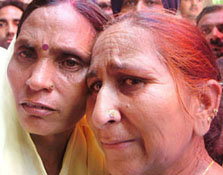
Image: Sukhpreet Kaur (l) and Sarabjit's sister, Dalbir Kaur (r)

Sarabjit Singh's case is probably the clearest case of government apathy and neglect. Why does the government always wake up at the last minute? And even when it does, it lacks the courage to take a strong stand.

Unlike the wife of Sarabjit Singh, whose statement below is probably the greatest display of patriotism that one has seen. Times of India has this report:

I am against exchange of terrorists: Sarabjit's wife
20 Mar 2008, 1211 hrs IST,TNN

NEW DELHI: Sarabjit Singh's wife Sukhpreet Kaur has opposed the idea of India freeing a hardcore terrorist in exchange of her husband's release.

Talking to TOI , she said: "My country must not release any terrorist in return of my husband." She was reacting to the speculation about the trading of Sarabjit with Afzal Guru, the mastermind behind Parliament attack. However, she said Pakistani nationals who had been languishing in Indian jails for mild offences could be released to secure her husband's freedom.

Denying that Sarabjit was a terrorist, she said that false cases had been registered against him.

(read more)


Its a pity our government has neglected these heroes. But what else can be expected from them.

Thursday, November 22, 2007

Kingdom of Worms

Rajasthan, Gujjar Protests, Naxalites stronger than ever, North-Eastern Militancy on the rise, Nandigram, and now, Protests in Kolkata against Taslima Nasreen. Welcome to the new, unsafe India.

The Financial Times has reported that Shivraj Patil, our bumbling, invisible Home Minister, has finally woken up to the devastation that is Nandigram. He came out with the following reply:

“We have given directives to the state government that no one should be forced to leave his or her home. Everybody should be brought back and given full protection,” Patil said. He added that the Centre had information that “some outsiders had instigated people from behind to take to violence. They also brought sophisticated weapons into the area”.
The CRPF has debunked the last statement. In a CNN-IBN report, CRPF DIG, Alok Raj has stated that there was no evidence of Maoist weapons or the presence of Armed Maoist Cadres. Perhaps Shivraj Patil got his names mixed up- it was the CPI(M)'s goonda's and armed terrorist militia who, armed with Bolt action rifles, country made pistols, machetes and even SLRs, marched into Nandigram, easily scattering the lathi-wielding locals, and embarked on their pillage of the area. Maoists were the scapegoats for the CPM leaders in Kolkata- easy targets, much like the Communists when the Reichstag burned.

The Home Minister's post has been been an extremely powerful and important post; but under Shivraj Patil's ineffective sleepover at the helm, it seems almost an honorary post. Patil, who, like Pratibha Patil and most other Congressmen, got his post due to his loyalty to "The Family" and to Madam Maino. He has seen the rise of the Naxal menace, which is now a threat of gargantuan proportions. Law and order in several areas has literally crumbled, and the weak government at the centre has meant that even small groups with political leverage have been able to hold the authorities to ransom.

The result- Internal security is worse than any other time in the past. As the government is more worried about its own survival and the Political fortunes of Crown Prince Rahul Gandhi, the conditions of poor people or the state of Police Forces is the least of their concerns. The main problem is the weak-kneed Congress Government. Even a bad decision is better than no decision. Unfortunately, thats something the UPA has forgotten, seeing how they are being pulled by all sides, each of which, however small, has the power to bring the government to a crashing fall. And that's something that Sonia Gandhi cannot stomach.

Then, there is the man at the helm. Much like the other seat-warmers in other posts, including Manmohan Singh, Patil is a true Sonia loyalist. Thats something thats rewarded, irrespective of how ill-fitting the man is to the post- just look at the other senile dinosaurs in the cabinet- Natwar Singh (who's thankfully gone), Arjun Singh (who, unfortunately, isn't off the 'reservation'
yet), Ambika Soni and Renuka Chaudhary. Patil hasn't been given any power by 10, Janpath, and unfortunately, he seems content with remaining a titular figurehead. The Home Minister must be strong-willed, and willing to make hard decisions that could cost them their careers. No one in the present government has the spine to do that. Look at our previous Home ministers- Sardar Patel, Rajaji, Lal Bahadur Sastri, Morarji Desai, and Lal Krishna Advani. And then, look at Shivraj Patil.

Till the next elections, theres little else to do but wait and pray that the country isn't destroyed by then. 'Coz at the way we're going, we'll probably get there pretty fast.

Wednesday, November 14, 2007

Arjun Mk.2 Approved

Finally, there was official army confirmation of the news that most well-informed insiders knew -
the Arjun Mk.2 will be developed. This was confirmed by the Army Chief during the 3-day AFV meet that is being organized by the Army in New Delhi. The short report from Zee News is scant on details, but I'll try and fill you in.

http://www.bharat-rakshak.com/NEWS/newsrf.php?newsid=9608

Army okays development of Arjun Mark II tanks


New Delhi, Nov 13: The army on Tuesday gave the go-ahead for developing next generation indigenous battle tanks after a successful run of the original model Arjun.

Based on its experience in designing the Arjun MBTs, the DRDO was coming up with a lighter and more versatile version called Arjun MK-II which is expected to meet future needs, Army chief General Deepak Kapoor told an international seminar on Armoured Fighting Vehicles here.

Defence scientists are also working on the Tank X project comprising features of Arjun and Russian-supplied T-72 tanks.

The function organised by the CII was presided over by Minister of State for Defence Rao Inderjit Singh, who asked Indian companies to invest and participate more in production of weapons systems.

Bureau Report
Some more details from IDRW.org report:
http://www.idrw.org/2007/11/13/indian_army_seeks_next_generation_battle_tank.html

Indian Army seeks next generation battle tank

The Indian Army has sought a new generation main battle tank (MBT) even as it reluctantly prepares to receive the homegrown Arjun tank that has been over three decades in the making.

'What we have today is mid-level technology. What we need is a tank of international quality,' Indian Army chief Gen. Deepak Kapoor said Tuesday.

'I have no doubt that the DRDO (Defence Research and Development Organisation) will be able to develop indigenous capabilities for coming up with a better answer and more versatile armoured fighting vehicle (than Arjun) in the future,' he added while speaking at the inaugural session of an international seminar on Armoured Fighting Vehicles, the first to be held here.

Kapoor also called for synergy between scientists, users and producers to ensure the delivery of a cutting-edge-technology tank.

'The scientists cannot work in isolation. The users (the army) should be with them. So also should the producers, be they the public sector undertakings or private players. Only then will we see an indigenous armoured fighting vehicle of international quality,' the army chief maintained.

Now, the Arjun Mk.1 never really found many supporters in the Army, many of whom were angry at the long gestation period and the constant problems. While the Arjun was, in theory, an excellent tank, it used a mish-mash of indigenous and foreign components, many tailor-developed for the Arjun. Obviously, with such high technology and the inexperience of scientists in the field use of these systems (not helped by the Army, which kept pushing Trial dates), the systems performed exceptionally well in the labs, but tanked in the Field.

But in the past two years, especially after the 2005 trials where the Army gave a clear to-do list to DRDO, these problems were systematically solved, and DRDO commenced a war-footing overhaul and repair work on the systems. Most of the problems were ironed out, and a grueling internal testing of the Arjun, which performed well. These efforts finally turned a corner a few months before exercise Ashwamedh, which was held in April this year.

Truly confident of their product, the DRDO was ready for user trials, but the Army wasn't. In a coup of sorts, the DRDO bulldozed the MoD and Army into including fifteen Arjuns in the large scale war games. The games, held in the hot Thar summer, also gave the Arjun an opportunity to show its new self, and its performance in heat, something that had caused it problems aplenty in previous trials. Less than pleased, there was nothing else for the Army to do but obey the Raksha Mantri's diktat. The results were clear. Arjun outgunned the Ajeyas and T-90s. The T-90s were beset with problems, many of them the same problems that had afflicted the Arjuns not so long ago- Suspension issues, Fire Control System Failures, and frequent stoppages.

In light of this new look Arjun, both DRDO and MoD were agitating for comparative trials, something that even the Army had, till a few months before, had been insisting upon. Suddenly, as the T-90s looked shaky, the Army got cold feet- after many postponements and delays, the Army finally cancelled the trails altogether, instead replacing them with an AUCRT, which should theoretically bring the Arjun into full scale service. But considering the Army's reactions, that seems doubtful.

But the message that the Army was getting was clear- the Arjun is world-class material, and with a little tweaking, could do a world of good. Plus, it would be foolish to rely on the T-90, a series whose development is reaching a plateau. After all, a small, light tank can only do so much. Plus, the T-90 is far worse protected than the Arjun, something that gives it a weight advantage, but at the cost of certain death to the crew in any conflict involving even moderately successful ATGMs. The T-90 would be hard-pressed against the newer tanks that will enter service around the world in a few years- the M1A2, Korean XK-2 and Al-Khalid upgrades, which will outgun the T-90. This, along with a need to expand the Armored Corps, led the Army to the revelation that it will need a modern tank in the future. There is a requirement for almost 3000 tanks to replace the old T-72s and Vijayanta tanks.

The Army has formulated a requirement, GSQR 2020, which will spell out the needs for a modern tank to be in service by 2020. This will be released to DRDO soon, and its clear that the Modernized Arjun, a Mk.2 variant will be able to fit the requirement. This will give the Army a fleet of Arjun Mk.2s and T-90s, a stable that echoes the WW2 style of different tank classes- Infantry and Cruiser Tanks.

The only question is, what name will the new tank be given? I have a suggestion- Abhimanyu.

Monday, November 12, 2007

India steps up production of Prithvi and BrahMos

This interesting report from Times of India caught my eye:

With Pakistan rapidly moving towards enlarging its missile arsenal with China’s help, India is slowly but steadily stepping up production of Prithvi surface-to-surface ballistic missiles, as well as BrahMos supersonic cruise missiles. Sources said facilities were now in place to produce around 20 Prithvi missiles every year, while the annual production rate of BrahMos missiles is geared towards touching 50 in the near future.

In 2006-2007, for instance, Hyderabad-based defence PSU Bharat Dynamics Limited for the first time managed to produce 15 full-fledged Prithvi missiles and four training missiles, apart from 18 warheads, said sources. While different Prithvi variants have strike ranges varying from 150-km to 350-km, the BrahMos missile developed with Russia can hit targets over 290-km away.

"Similar plans to step up production of the strategic missiles (700-km Agni-I and 2,000-km-plus Agni-II ballistic missiles) are in the pipeline," said a source.

While Army has had its 150-km Prithvi-I missiles for some years now, IAF and Navy operationalised their longer-range variants of the same missile recently. Navy, for instance, is weaponising its Sukanya-class large patrol crafts with Prithvi’s ‘Dhanush’ variant, which has a strike range of 250-km to 350-km. IAF, in turn, has started moving its Prithvi-II missile squadrons from Hyderabad to some airbases closer to the western front.

As for the air-breathing BrahMos missiles, which fly at a speed of 2.8 Mach, Navy was the first service to equip its frontline warships like Rajput-class destroyers with their vertical launch systems. The Army, which already has missile groups to handle Prithvi, Agni-I and Agni-II, is now also operationalising BrahMos land-attack cruise missiles (LACMs) as its "precision strike weapon."

Work on BrahMos’ air-launched version for Sukhoi-30MKI multi-role fighters, however, had been hit by delays. Consequently, this missile will be integrated with the naval IL-38 maritime patrol aircraft as the first step.

Incidentally, Pakistan tested a new air-launched 350-km range cruise missile, ‘Hatf-8’ or ‘Thunder’, a couple of months ago. Moreover, its ‘Babur’ cruise missile, said to be capable of carrying nuclear warheads to 500 km, is already on course for large-scale induction. Indian defence scientists, too, are working on a wide array of missile programmes, which interestingly also include submarine-launched versions of both Prithvi (K-15) and BrahMos missiles.

The Agni-III missile, with a 3,500-km strike range meant for China, will be ready by 2010 after a few more tests. Then an advanced 5,000-km range Agni missile, with a third mini-stage being added to the two-stage Agni-III, is also on the anvil.

Similarly, work is also in progress to develop submarine-launched cruise and ballistic missiles under the ‘Sagarika’ project to complete India’s ‘nuclear triad’ — the ability to fire nuclear-tipped missiles from the air, land and sea.

Sunday, October 28, 2007

DRDO develops Micro-UAV

Here's a report from the Khaleej Times that caught my eye (Link1, Link2) about DRDO developing a new Micro-UAV:

DRDO develops tiny spy gadget
(IANS)
28 October 2007


AGRA — Indian scientists have developed a tiny gadget that can keep an eye on enemy territory and help in traffic management.

The details of the device were disclosed at the first national flying competition of Micro Aerial Vehicles (MICAV) at the Aerial Delivery Research and Development Establishment (ADRDE) of DRDO here.

Lt. Gen. V.J. Sundaram and Balraj Gupta of the DRDO, on Friday said the tiny unmanned device can remain in air for 15 to 20 minutes and send photographic data to computer networks. Soldiers on the borders can also use it to observe movements across enemy lines. Only 30 cm wide, the device looks like a bird to untrained eyes. It can survey an area of roughly one square kilometre from a height of 500 metres. It weighs about 400 gm and is powered by a rechargeable battery.

Sources said the actual production of the device could take as long as three years after a series of field trials and improvements from feedback were made available.

Agra will host an international MICAV competition in March 2008 in which teams from Japan, the US, France, Britain, Israel and some other countries are expected to participate. (Source)
One wonders why the Indian media haven't heard about this yet. Guess we'll be waiting for more information from DRDO.

Chemical Imbalance

The electronic media is at it again. This time, its India's chemical weapons arsenal. One general statement from Army Chief Gen. Deepak Kapoor, and Vishal Thapar has created a story out of thin air. This is pure sensationalism, or worse. Not only is the story full of holes and mistakes, but the basic premise itself is a fallacy. Here's why.

This is the report on CNN-IBN. (Story link). The video is embedded below:


To say that the report is full of holes would be an understatement of monumental proportions. What Thapar has done is to take a single sentence of Gen. Kapoor, remove the context, add unreferenced information, add his own conclusions, all cooked with a good bit of mirch masala to create a news story thats frivolous at best.

Firstly, India's Treaty obligations that was referred to is the Chemical Weapons Convention (CWC). Its administered by an independent body, the Organization for the Prohibition of Chemical Weapons (homepage). Its heartening to note that unlike other treaties, this is almost universally accepted, and has been ratified by 182 states (see list), and signed by another six.

Now, lets be clear. India's cache of Chemical weapons is no secret, contrary to Thapar's assertion. After ratifying the CWC in 1997, India has diligently fulfilled all its treaty obligations, dismantled over 80% of its weapons, and is on course to complete disarmament by 2009. The 2006 Annual report of the OPCW states much the same thing. And it should be an indicator of the sagacity of our administrators that the Armed Forces were kept out of the loop, thus reducing the risk of a WMD escalation in the subcontinent. It was a wise decision and not a blot on India's strategic culture.

This is what the OPCW says about India's commitments:

India has received an extension to 28 April 2009 of the deadline by which it must destroy all of its Category 1 chemical weapons stockpiles India has already destroyed 80% of its category 1 CW stockpile as well as 100% of its declared Category 2 and 3 chemical weapons.
Under the treaty (Part VI, Verification Annex), states are allowed to produce upto 10 kg of Schedule I chemicals annually. Any production over 100 gms must be declared. It would be laughable to call this production an "arsenal". Such production serves the purpose of improving Chemical Weapon protection and understanding of the Physiological effects of these chemicals. If dear Mr. Thapar wishes that we cease even this critical production in an effort to better protect our soldiers and people, there is nothing to be said.

Another allegation that Thapar immaturely makes (without offering any substantiation) is that the Army continues to be doctrinally committed to Chemical Weapons. That is a very serious claim, but no further explanation is offered. Why is that? Is it because it is too embarrassing, is the source confidential, was there a lack of time, or was it simple because there wasn't any proof?

The only bit of the article (which is as flimsy as a bamboo hut in a hurricane) that Thapar didn't make up, misquote or fib was the single sentence of the CAS that he used as a keystone to build around. Analyzing what Gen. Kapoor said,
“The chemical weapons aspect is still in the domain of discussions going on at an international level,” Kapoor said.
This is vague, but its hard to see how its even close to the conclusion that Vishal Thapar has drawn. And it certainly wasn't forced out of the Chief's mouth, like Thapar claims. Most likely, the Army Chief was referring to the CWC treaty and the disarmament process. Either way, its hard to know the context of his reply unless the whole quote was included. Unfortunately, the reporter has deigned that objectivity unimportant compared to his expert "findings".

The best indicator of Vishal Thapar's intentions is this statement, inserted at the bottom of the report, and not included in the Video.
For the record, Pakistan has declared a zero stockpile.
Well, for the Record, India ratified the CWC seven months before Pakistan did (India ratified on 29th Apr 1997, while Pakistan ratified on 27th Nov 1997).

Its not unlike Vishal Thapar, who never misses an opportunity to cock a snook at the Defence Establishment, whether it be this report, or his previous one about the Missile tests. The smear campaign is not worth responding to, but the serious and fraudulent claims that he has made are. Hopefully the Army or MoD will come forward to rubbish this slander campaign.

Thursday, October 25, 2007

Newsflash: LCA Fires Missile

This is a newsflash from Chacko Joseph of Frontier India, who has confirmed that the LCA PV-1 has successfully fired a Vympel R-73 Air to Air Missile during Missile Trials in Dabolim, Goa.

This is a HUGE step forward for Indian Aerospace, and marks a turning point in the Operational Clearance process for the Tejas, and marks the first milestone of the weaponization process. Many more trials will have to be conducted, but this is a first step.

I saw a picture of the first LCA test flight. The whole team was up in the air, like little schoolboys cheering in a cricket match, without thought of the VIPs and VVIPs around (many of whom were also jumping up and down in glee). Today would have been the second of such cheerfully tearful days. Congratulations to the LCA team, and all those who poured their heart and soul into the program, which is finally bearing fruit. And Congrats to Chacko Joseph who first reported this news. Keep it up all.

Heres the report from Frontier India (link):

LCA firing the R-73 (Pictures courtesy DRDO, taken from Frontier India)

Tejas fires its first missile

Written on October 25, 2007 – 6:53 pm | by FIDSNS |

The Light Combat Aircraft ‘TEJAS’ program achieved the most significant milestone yet when it successfully test fired the Close Combat Missile R-73 today at the air to air range off Goa coast. The historic event marks the beginning of weaponisation, which is the focus of the current initial operational clearance (IOC) phase of the program. Air to Air missile integration and testing especially on a fly by wire aircraft is a very complex task involving interfaces with aerodynamics, engine air intake, control laws, flight control system, avionics system, electrical and other general system of aircraft. Today’s successful test firing is the culmination of preparatory work under the guidance of Mr. JJ Jadhav, DPD (Weapon Systems) and Mr. Balasubramanyam, AGM (HAL). Accordingly the main objectives of test firing were to validate:

•Safe separation of the missile from the parent aircraft.
•Effect of missile plume on engine air-intake
•Functionality of store management system (SMS) including safety interlocks
•Effect of missile plume on composites structures
•Handling quality assessment during missile launch

The historic flight was done on Tejas prototype vehicle PV-1, piloted by the Chief Test Pilot of the National Flight Test Centre ADA, Gp Capt. N. Harish. The test firing was done at 7 km altitude and 0.6 Mach.... (read more)

Tuesday, October 9, 2007

75 years: Soaring hopes and Ambitious plans

At the 75th Anniversary Celebrations of the Indian Air Force at Hindon Air Base, the rows of VVIPs (Including the president, Vice-prez, PM and group) were enthralled by our hi-flying boys-in-blue. And what better occasion to trumpet the achievements and plans of the IAF. Chief of Air Staff, Air Marshal Major's address did just that; and in the process, helped clear up a lot of confusion, and provide a checklist (almost) of the Force's plans for the next few years.

You can check out the full address at Press Info. Bureau of GoI. (Link)

The Press releases for the MoD can be found here.


Some juicy tit-bits provided by the CAS are:

Aircraft Entering Service:

- Hawk AJTs- Will arrive next month.
- Phalcon AWACS- Will be here next year.
- LCA - 1st sqn operational by 2010 (IOC)

Contracts to be signed soon:

- 6 C-130J 'Super Hercules' Tactical Transport Aircraft for the Special Forces.
- 80 Mi-17 1Vs.
- 54 ALH Dhruvs.
- Aerostats for Air Defence and over-the-horizon Surveillance {{Obviously from Israel}}.

Upgrades:

- Jaguar & Mig-27 - Upgrades almost done
- Mirage-2000 & MIg-29 - Being Negotiated
- Il-76, An-32, Helos - Will start after that

Other:

- Integration of Civil Radars.
- 'Combat Communications Network' to be set up.
- Joint Design & Development of 5th Gen Fighter Aircraft and MTA (Medium Transport Aircraft) being negotiated. {{This is probably the clearest indicator that the FGFA project is not the PAK-FA being developed by Russia, since its design has been frozen.}}

Saturday, October 6, 2007

Shiv Aroor's Arjun Ride

Here is the half hour Headlines Today special about the Arjun MBT, filed by Shiv Aroor (Blog) from the Heavy Vehicles Factory and CVRDE testing range in Avadi, Chennai. The lucky fellow got to spend two full days with the Tank, and was even given a chance to take it for a spin and get a few bumps and scratches on the paint.

There isn't much new information about the Tank thats said in the report, which is understandable given that the focus is on the layman who doesn't know a T-72 from a Mig. The camera-work is patchy, and wastes a lot of time showing repeats of the road-rage antics of Shiv the Driver. Still, considering that its a 20 minute long report, there are still some great bits of info, most notably a look into the impressive state-of-the-art manufacturing facility for the Arjuns. In addition, there are lots of small bits of info that can be gleaned by careful observers and enthusiastic analysts.

Shiv has a post on his impressions at his blog:
http://livefist.blogspot.com/2007/10/what-now-arjun.html


Take a look:

Part 1:


Part 2:


This latest piece echos Ajai Shukla's report about the Arjun in May, where he too did not have any criticisms of the Tank.

At that time, there was a palpable sense of both hope and anxiety. Hope because the DRDO was confident that it had a world-class product that would come out on top in the comparative trials; anxiety because the Army is notoriously obstinate about having exactly what it wants (even with best-of-Brochuritis). In addition, Arjun's long development and a strong Russian Arms Lobby make it all the more disliked by the Brass.

With the cancellation of the Comparative Trials, a travesty of monumental proportions, the DRDO's fears came true, but they quickly salvaged it by planning the Accelerated User Trials. Lets hope this isn't another hogwash. One thing is clear though- the Arjun has arrived.

Its a great achievement on part of the DRDO PR apparatus that they have converted two people, who till recently were hacking at the Arjun and DRDO. Lets hope they can convince the Generals as well.

Friday, August 31, 2007

Indo-US Nuclear Deal- Full Text

Manoj Joshi, whose blog is both interesting and eloquent, has been kind enough to trawl through the MEA's website and find the full text document of the Indo-US 123 Deal (in pdf format).

If you're interested in reading and analyzing it, you can check out the download link at http://www.savefile.com/files/946023. The file will be up for a month (more, depending upon the number of downloads).

The full text can also be found on the US State Department Website at http://www.state.gov/r/pa/prs/ps/2007/aug/90050.htm

While you're at it, you can also download the July 18 2005 Agreement text (pdf document) from the MEA website (Bilateral Treaties and Documents section):

Implementation of the India-United States Joint Statement of July 18, 2005: India’s Separation Plan

Friday, June 29, 2007

MRCA Tender- RFP cleared for Release

MRCA Contract Update- June 29

Over the past week, theres been a flurry of activity on the MRCA scene. Last week, AK Antony said that the Defence Acquisition Committee (DAC) would meet and approve the Request for Proposal (RFP) for release within the fortnight. That report was on the 18th. Luckily, the DAC met the deadline. Yesterday, the DAC met in Delhi and cleared the purchase of the 126 fighter jets.

The big news was reported by various newspapers. Unfortunately, its hard to trust most of these reporters (for reasons well known), and so, an official MoD source was needed. That press release is given below.

An Analysis of this news is on the way. The press release by itself is quite detailed, and a lot can be inferred from it. The most important observation is the name "Medium Multi Role Combat Aircraft", which suggests that the IAF is no longer looking for a Mig-21 replacement, but is looking to boost the number of medium weight class (Max. Takeoff Wt. of 20-25 tons) aircraft, which do the bulk of "Earth-mover" work in strike roles. That is, in any mission, these aircraft would be the bomb carriers and the core of the formation, while other aircraft, like the LCA and Su-30 would provide air cover. This class, capable of carrying over 6 tons of weapons (9-10 tons
of load, i.e. Weapons + Fuel), is crucial for the IAF, which has been looking to shore up the numbers and replace the Mig-27s and Jaguars that are getting old.

This also means that the MoD is no longer worried about the progress of the LCA project. Reports before would regularly talk about the MRCA being floated due to delays in the LCA project. But, considering the progress of the Tejas, that doesn't seem to be a worry any more.

The MoD Press Release:
http://pib.nic.in/release/release.asp?relid=28894

DEFENCE ACQUISITION COUNCIL CLEARS PROCUREMENT 126 MMRCA

The Defence Acquisition Council (DAC) headed by the Defence Minister Shri AK Antony has cleared the process for the procurement of 126 Medium Multi Role Combat Aircraft (MMRCA) for the Indian Air Force. During its meeting here today, the DAC debated various issues related to the initial purchase, transfer of technology, licensed production and life time maintenance support for the 126 MMRCA and gave the final go-ahead for the project.

In pursuant to the recent assurance given by the Defence Minister for an early issue of the much awaited Request for Proposal (RFP) for the 126 fighter jets, the Ministry of Defence and Indian Air Force officers have been working overtime to scrutinize all aspects of the RFP. In view of the size and operational importance of the likely purchase, the criteria for selecting the final MMRCA contender from amongst some of the best combat aircraft offered by American, Russian and European companies, has been fine tuned. The RFP would contain a selection model that would involve an exhaustive evaluation process as detailed in the Defence Procurement Procedures — 2006.

The proposals from the likely contenders would first be technically evaluated by a professional team to check for compliance with IAF’s operational requirements and other RFP conditions. Extensive field trials would be carried out to evaluate the performance. Finally, the commercial proposal of the vendors, short-listed after technical and field evaluations, would be examined and compared. The aircraft are likely to be in service for over 40 years. The vendors are required to provide a life time support and performance based warranty for the aircraft. MoD officials have confirmed that great care has been taken to ensure that only determinable factors, which do not lend themselves to any subjectivity, are included in the commercial selection model. The selection would be transparent and fair.

The DAC has approved that a majority of the MMRCA would be produced in India under transfer of technology. The vendor finally selected would also b e required to undertake offset obligations in India. It is expected that the ToT and offset contracts would provide a great technological and economic boost to the indigenous defence industries, which would include DPSUs, RURs and other eligible private sector industries. Foreign vendors would be provided great flexibility in effecting tie-up with Indian partners, for this purpose.

There are three guiding principles for this procurement scheme. First, the operational requirements of IAF should be fully met. Second, the selection process should be competitive, fair and transparent, so that best value for money is realized. Lastly, Indian defence industries should get an opportunity to grow to global scales.

With the decks finally cleared, the RFP is planned to be issued in the near future.

Sitanshu Kar

An earlier report by the Indian Express, dated 18th June is given below.

http://www.indianexpress.com/story/33998.html

PANEL MEET SOON TO DECIDE ON IAF’S 126 FIGHTERS CONTRACT

New Delhi, June 18: The decks have been cleared for India’s biggest ever global defence tender to acquire 126 multi role combat aircraft. Defence Minister A K Antony on Monday said the Defence Acquisition Committee (DAC) will meet within a fortnight to finalise the tender document.

“The DAC will meet within a fortnight and decide on the RFP. All negotiations are over and now it is a question of formalities,” the Minister told media persons after inaugurating a two-day annual Unified Commander’s Conference.


He indicated that issues like factoring in life-cycle costs and clauses of the offset policy have been resolved by saying that the final Request for Proposals would be issued within “one or two months”.


Meanwhile, Air Chief Marshal F H Homi left on Monday for a five-day France visit. He will attend the Paris Air Show that will showcase contenders for the contract like the American F-16 and F/A 18 Super Hornet, the French Rafale, Russian MiG 35 and the Swedish Gripen.


Speaking on the LTTE threat, ... (unrelated issues continued).


More Reports:
(note- links shown here may have been shortened. If you're not able to see, right click and copy link location.)
http://www.hindu.com/2007/06/29/stories/2007062954320900.htm

http://www.indiaprwire.com/businessnews/20070628/23165.htm
http://www.ndtv.com/convergence/ndtv/story.aspx
http://economictimes.indiatimes.com/India_to_buy_126_fighter_jets
CNN Money Report
International Herald Tribune Report
Reuters India Report
http://www.earthtimes.org/articles/show/77788.html

For more reports, see Google News. A Collection of reports like the ones above can be found here.

Interview with Dr. Atre

Frontier India has an extremely informative interview with Former Scientific Advisor Dr. V.K. Atre, who is uncharacteristically blunt and direct about the level of commitment the Services have shown in DRDO projects, preferring to go in for foreign solutions. Considering that Dr. Atre has rarely given interviews & has never criticized the Armed Forces or media before, this is really a revelation, and a wake-up call.

The former DRDO Chief is clear that DRDO has got a lot of flak that it scarcely deserves- the Sources, Armed Forces, An Ignorant Media, Foreign Vendors and the Import Lobby, all with an axe to grind, an interest to serve, or simply trying to cover their own mistakes.

DRDO-bashing is the easiest thing to do, since it is the focal point of all indigenous weapon systems development. Production & Quality problems are blamed on DRDO, even though it doesn't produce equipment, only develop it. Delays are caused by the services, which delay or mess up Staff Quality requirements (the Redesign of LCA wings, or the Arjun Project), or MoD bureaucrats who sit on files, or push pennies to try and save money, at the expense of destroying national security. All these are conveniently forgotten when journalists blame DRDO for any problem that ails the defence projects. And with an active defence contractor Lobby that will do anything for billion-dollar cheques and an easily-influenced media, its no wonder that the spate of recent anti-DRDO rants have been published.

We must be clear that DRDO is at fault in many cases, and is not perfect. But the fact remains that it has been expected to develop world-class systems for costs that Foreign companies throw monthly parties for. Look at the Trishul- how can anyone expect results for a measly $70 mn. Or the LCA, which has reached the stage its at for just $500 mn. The F-22 Raptor has already spent over $60 Billion, and the JSF another 15 billion. The much maligned Arjun has spent only 315 crores to reach the state its in now. And it is a world-class system comparable with the Abrams (which was a $6 bn project) and the latest Leopard 2s.

Dr. Atre comes out strongly against these criticisms and has presented a strong defence of the DRDO, which has had to navigate through a lot of dirt hurled at it to get crucial projects ready. Frontier India also has a lot of other related articles that together, tell the same sad story of conspiracy and slander against the DRDO, which has had to keep quiet and rely on retired officials to defend it. Please read this extremely well written piece (link: http://frontierindia.net/indigenous-defence-research-looking-through-drdo-prism/).

P.S.: Keep looking out for good news on the Defence projects front. A little birdie (Mr. Chacko Joseph from Frontier actually) tells me that a lot of great news is coming up... will update as it comes out.


Indigenous defence research - looking through DRDO prism

Indian Armed Forces are used to import Defence systems from abroad and use them mostly for training and during operations whenever necessity rises. Most of these systems are in free flow production in their respective countries and sometimes inducted by their Services. These systems, therefore, have got the maturity in terms of engineering, production and maintenance. This provides the comfort zone for the three Services to induct, operationalise and maintain these weapons.

The most important aspect is that these weapons, are not designed keeping Indian environment, tactics, operational doctrines or user’ preferences in mind. They are not customized for the convenience of the Indian Armed Forces. Even then, they are accepted by the Services based on their maturity level. Even in those cases where partial quantities are produced in the country, mostly in Indian Ordnance factories (OFB) and Defence Public Sector Units (DPSUs), there is hardly any technology transfer taking place. These items would already have been produced in large quantities in their respective countries and would have reached end of production life for their own use. Many times, the tooling will be transferred to Indian production line accordingly. Though the products are subsequently made in India, most of the raw materials and components still have to come from the parent country and the value addition by Indian Industry is very small, varying from 10% to 30%. Even then, this is a preferred route for the OFB’s and DPSUs as there is no risk for them. They have assured product line and order quantities from the Armed Forces. Most of time, the critical high end system’s technology is not passed to India. It is a form of “Technology Apartheid.” India ends up paying exorbitant prices and foreign exchange.

The international arms market runs with political and monetary diplomacy. The arms majors adopt all tricks of trade to push their wares. India is one of the largest importers of arms in the world, hence these issues imply to India too.

With this background, it is natural that the Indian Armed forces hesitate to accept Defence Research and Development Organisation (DRDO) developed items as they know that even after DRDO successfully develops, there would be a reasonable time gap before a smooth free flow production gets established by the Indian Industry. There is also pressure from import lobbies and vested interest which cultivate the sensation seeking mass media for defaming Indian indigenous research.

It is to be noted that all countries which develops a complex defence system has gone through the same pains and problems as DRDO before serial production gets established.

Frontier India Defence and Strategic News Service interacted with Dr. VK Atre who has held the position of Scientific Advisor to Minister of Defence. I covered in depth on the DRDO point of view on the state of indigenous Defence Research.

There are 4 state actors when it comes to indigenization of weapons.

1) The Ministry of Defence (MoD)
2) The Armed Forces
3) The Defence Research and Development Organisation (DRDO)
4) The Public sector defence production units (DPSU)

There are 3 non state actors which influence the outcomes
1) Foreign Vendors
2) The Mass Media.
3) The Import Lobby

The Ministry of Defence

Ideally the MoD should act as the bridge between the scientific & technical community and the armed forces.

On the role of MoD in indigenization Dr. Atre say’s “Variable. There are occasions when MoD has supported DRDO strongly and there are occasions when they have not. It depends.... (read more)

Thursday, May 17, 2007

Religious Census of army stopped

The MoD has decided not to go ahead with the religious census of the Indian Armed forces.

This information was provided by A.K. Antony in the Rajya Sabha in a written reply to Syed Azeez Pasha in Rajya Sabha today (16 May). (The information can be found at
the Defence Ministry website under press releases).

The ministry wrote:

Armed Forces have a secular and apolitical character. Recruitment to the Forces is based on merit and is open to every citizen of the country without any discrimination on the basis of their case, creed, religion or region. All the personnel from all communities and regions work together without any distinction on the basis of caste, creed or religion. Therefore, it was not considered desirable to supply any data relating to particular religious community in respect of the Army as it would have affected the ethos and cohesiveness of the forces.
This is good news, and the leadership and soldiery of the armed forces will surely heave a collective sigh of relief.

Unfortunately, this is not the first time, nor will it be the last, that the government has interfered with the affairs of our Armed Forces. It started with Nehru, when 'loyal' officers were handpicked and promoted, at the expense of experience. The debacle in 1962 was partly a result of this crony-ism. Subsequent governments have tried to dabble in the workings of the army. This has partly stemmed from a fear of the Armed Forces, especially considering the dictatorships that have come to power in the region, an ambition of the politicians to control the army, and make it do their bidding (like they wish to do with most of the country's machinery) and their use of it for their own political ends.

This has mostly not had any lasting or deep effect on the Services, who have grudgingly adapted to them, or shrug the netas off and forgotten their actions.

However, last year's order of the UPA government, in its pursuit of 'secularism' and efforts to woo the minorities set off a veritable flood of bottled up discontent from the Forces, retired officers and generals and Commentators, who saw this as the political machinery's blind attempt to pander to their constituents without caring about the long-term effect on the Army. This order threatened the Army's ethos more than Nehru's policies, the 1962 war, or Bluestar. If implemented, this would have destroyed the secular and moral fabric of the Indian Army, where people of all regions, communities, castes and colours have ought and died together, protecting us.

Col. Athale wrote an excellent piece in Rediff.com about this issue:
After its projects to change Indian history to 'secular' history, the United Progressive Alliance govt seems to have launched a project to make the army 'secular'.
....
....

It is undoubtedly true that the number of Muslims in the Army is less than their proportion in the population. This is a historical legacy as the recruitment of Muslims in the armed forces in pre-Independence India was concentrated in Punjab, North West Frontier and Balochistan, all part of Pakistan today.

A similar argument can be also made on the basis of region. The states of Orissa or Gujarat or even Andhra Pradesh are not represented in proportion to their population. To assume any bias on this basis is to see evil where none exists.
He concludes:
Many former and serving soldiers believe that this data collection is the thin end of the wedge of introducing religion or caste-based reservations in the armed forces.

The Sachar Committee's bias has been clearly shown by their reliance on foreign research. It is time the government prohibits the Sachar Committee from dealing with the armed forces.

This does not mean that the government should not ask the army to conduct an exercise as to why the proportion of Muslims or Christians or Gujaratis is less in the armed forces.

Finally a counter question to the Sachar Committee: What is the proportion of Muslim employees in Muslim-owned companies like Wipro and Cipla? If it is less than their proportion in population, do we take it that the Muslim owners of these companies are also against the minorities?

Is there no limit to 'vote bank' politics, for the sake of which a government is prepared to destroy the efficiency and cohesion of its armed forces and jeopardise the nation's security?
Omar Khalidi, author of the controversial book, Khaki and Ethnic Violence in India, which reportedly sparked off this controversy has also given his views on this issue (see
http://in.rediff.com/news/2006/feb/18inter2.htm
).

The government's present stance is a 180 turn from Sonia Gandhi's views last year. Perhaps they realized that their quest for 'equality' and votes would harm them in the long run. Or perhaps the top Brass of the Forces decided that enough was enough and decided to make their views clear. Yet, the interference in Army affairs continues. The Supreme Court's spate of orders regarding Army affairs is another example. The armed forces are not all rosy themselves though. Rampant abuses of power, corruption and questionable policies are rife, and do warrant attention and action from the Courts and the Government. However, this must not be an excuse for increased bureaucratic control of our Armed Personnel, and there must be synergic efforts to improve the workings of the Forces. Else, we will see another 1962, and the people in charge would not know what to do.

For now, the Armed forces are safe. Yet, complacency is not an option. Else, there won't be an Army to help out during calamities and Riots. Instead, we may end up seeing Jawans fighting each other and joining the mobs like policemen have repeatedly done. That would be the end of the Indian state as we know it, and the end of the 250 year old institution that is the Indian Army.

As Chalmers Johnson says in Eugene Jarecki's documentary, 'Why we Fight'; "The price of Liberty is eternal vigilance". We must be vigilant.