Thursday, March 20, 2008

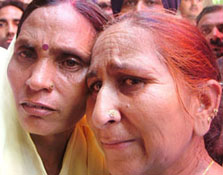
Sarabjit's wife: "I am against exchange of terrorists"

Image: Sukhpreet Kaur (l) and Sarabjit's sister, Dalbir Kaur (r)

Sarabjit Singh's case is probably the clearest case of government apathy and neglect. Why does the government always wake up at the last minute? And even when it does, it lacks the courage to take a strong stand.

Unlike the wife of Sarabjit Singh, whose statement below is probably the greatest display of patriotism that one has seen. Times of India has this report:

I am against exchange of terrorists: Sarabjit's wife
20 Mar 2008, 1211 hrs IST,TNN

NEW DELHI: Sarabjit Singh's wife Sukhpreet Kaur has opposed the idea of India freeing a hardcore terrorist in exchange of her husband's release.

Talking to TOI , she said: "My country must not release any terrorist in return of my husband." She was reacting to the speculation about the trading of Sarabjit with Afzal Guru, the mastermind behind Parliament attack. However, she said Pakistani nationals who had been languishing in Indian jails for mild offences could be released to secure her husband's freedom.

Denying that Sarabjit was a terrorist, she said that false cases had been registered against him.

(read more)


Its a pity our government has neglected these heroes. But what else can be expected from them.

Wednesday, March 19, 2008

Vassals of the Dragon Kingdom

The Chinese call their nation "Zhong Guo", or literally, "Middle Country". More explicitly, its their way of asserting the primacy of all things Chinese, and reaffirm how their nation is the centre of the world.

Nothing wrong in this worldview at all. After all, every single country thinks the same of itself. The problem is when others forget their own loyalties and patriotism and reiterate the same views. I'm of course talking about the Left parties of India. Its pretty obvious by now that CPI(M), CPI, and co. have absolutely no interest in keeping India alive. They were overtly supportive of the chinese aggression in '62 (only the threat of a treason charge made them come to their senses, after which they have been a bit more discreet). If recent evidence from the CIA Family Jewels and the Mitrokhin Archives are to be believed, they were, and still are ideal recruiting grounds for Russian, and later, Chinese intelligence agencies.

Its these fake patriots, the hypocritical idealists and third international seeking apparitchiks from Little Beijing in Kolkota who are the biggest danger to our stability, more so now that they have the government by the gonads (tiny as they may be).

This report from ToI probably best describes the hypocrisy of the Maroon (more red than the reds) parties:

Left silent as House erupts over Tibet crackdown
18 Mar 2008, 0159 hrs IST

NEW DELHI: Usually at the forefront of action in Parliament, particularly over human rights issues, the Left presented a muted picture on Monday as MPs expressed anguish and concern over the crackdown on protesting monks in Tibet.

As MPs demanded that the government condemn the Chinese action, Left members remained silent spectators. In Lok Sabha, BJP, BJD and SP members criticized the crackdown in Tibet and some like Gorakhpur MP Adityanath took a sharp dig at Left MPs, referring to them as "China’s representatives" in Parliament.

Though a much smaller provocation, particularly from BJP, would normally have had Left benches on their feet, this time around they heard the yogi out without saying a word.

Adityanath said that Chinese brutality in Tibet reflected Beijing's expansionist mindset and urged the government to intervene. He pointed out that China had expressed disdain for Indian sensibilities on issues like Arunachal Pradesh where even a visit by Prime Minister Manmohan Singh was enough cause for a Chinese protest. A similarly intolerant attitude was reflected in the action against Tibetan monks.

The Left's silence was all the more striking as the "Red" parties have spent most of last year strenuously denying that their opposition to the India-US nuclear deal had anything to do with their "soft" spot for China which has not been too comfortable about India officially becoming a member of the nuclear club.

The refusal to be even mildly critical of China coincided with the "off-the-record" insinuation from UPA partners that CPM and others have been blocking the nuclear deal with the US because of their sympathies with China.

The anger over Chinese "repression", expressed by others like BJP’s V K Malhotra, SP's Ramjilal Suman and BJD's B Mahtab, did put the government in a spot. Though MPs made it a point to note that Tibetan spiritual leader Dalai Lama had spoken of autonomy and not independence, it was not easy for government to concede the opposition's demands as India walks a tightrope with China on border issues.

The proceedings in Lok Sabha also brought out the dilemma that government faces in formulating its stand on Tibet. While India cannot condone the scale of the Chinese crackdown and the drive to deny Tibetans their culture and religion, any overtly sympathetic stance towards the "independence" demand raised by the protesters will be fraught with implications for Jammu and Kashmir too.

This compulsion was evident when foreign minister Pranab Mukherjee limited himself to reiterating the official response released on Saturday that India was concerned over the unsettled conditions, violence and deaths of innocent people in Tibet. When NDA staged a walkout, expressing its dissatisfaction with the minister's remarks, Mukherjee said the Opposition alliance had adopted no different policy with regard to China when it had held office.

"There has been no change since 1959," he said, pointing out that BJP veteran Atal Bihari Vajpayee had been foreign minister in 1977 and visited China as PM later.

In Rajya Sabha, raising the issue during zero hour, former foreign minister Yashwant Sinha (BJP) said what was happening in Tibet was Chinese misrule and a cultural genocide. He said what was worse was that the Chinese government had termed it "people's war" against people of China.

Sinha also criticized the Indian government for the repression against Tibetans settled here. "Good relation with China does not mean being a mute spectator," he said, demanding a response from the government.

Bravo! Bravo! Now, if only the BJP had the balls to start the process when they were in power. One hopes that they will walk the walk when they come back to power.

Monday, March 10, 2008

Singapore Air Show 2 - Global Hawk

More pics from the Singapore Air Show. You can check out http://frontierindia.net/album/main.php?g2_itemId=20for more pictures.

All pictures are (c) Sniperz11 (me). Please credit when posting them. For reuse or licensing, please email me (see the welcome message for the email id). Thanks.

This set are pictures of the Global Hawk . It may not look like much, but its a very imposing aircraft in real life, made more so by the fact that it doesnt have a pilot at the helm.

What an imposing and menacing presence it has - unfeeling, unyielding. Like something straight out of the Terminator. I wonder what the Talibs and Al-Queda guys think about that.

Thats what I'm talking about - eerie!
Nice Contrast against the gathering storm clouds.
The Block 20 Global Hawk, which is a upgrade over the present Block 10 variant is longer, larger, has a longer wingspan, and has a larger payload capacity.The information board for the Global Hawk. Observe the Electro optical image of the Space Shuttle Discovery on Piggy back of the Boeing 747 at Edwards AFB, California. The image on the left is a SAR image of an SA-3 battery south of Baghdad, taken during a sandstorm. The gimballed SAR antenna can scan from side to side to obtain 3 ft resolution images.

Sunday, March 9, 2008

Nag missile test video

Ajai Shukla has put up a video of one of the tests of the Nag Anti-tank missile (from 2006). He has kindly allowed me to put it up on youtube. Take a look at how the Nag destroys the target:


(00:58 duration. source: http://www.youtube.com/watch?v=fYVgeZn2Vjc. Taken from http://ajaishukla.blogspot.com/2008/03/nag-missile-test-2006.html)

Lord of the lies

As if in response to the hammering they've got, CNN-IBN's Vishal Thapar the great, of Chemical Goofups and lifafagiri fame, has come up with a great way to put down the Navy's test of the Brahmos Land Attack missile variant last week. Looks like Vishal-bhai wants to create issues where none exist. This time, its Environmentalism.

Check out his report of March 5th: (CNN-IBN Report link)

Indian Navy flexes its muscle, tests Brahmos missile
Vishal Thapar / CNN-IBN
Published on Wed, Mar 05, 2008 at 23:05

New Delhi: For the first time, India has used the Andaman Islands as a missile target. A Brahmos cruise missile was launched from a warship at sea on Wednesday to destroy a target on an uninhabited island.

But the missile test could also open up an environmental debate.

On Wednesday, India sought to validate its navy's land attack capability by pulverising a target on an uninhabited island in the North Andaman.

The weapon was a Brahmos cruise missile, and the launch pad a Rajput class destroyer 300 km away in the Bay of Bengal.

"The naval capability must acquire enough muscle to be able to significantly influence the battle on land," says defence analyst Commodore C Uday Bhaskar."

Never before has India actually tested a naval missile against a target on land.

The problem was the lack of availability of an uninhabited stretch on the mainland.

Hence, the choice of the Andaman as many small islands there are uninhabited and is a place where a missile hit poses perhaps the least visible collateral impact.

And there are international precedents. But even military analysts concede that there's an ecological cost.

"It would be incorrect to suggest that delivery of ordinance will have not have an environmental impact. It always does," Commodore Bhaskar adds.

The Andaman seems set to get a more military colour. It's not just about a missile firing range or a test bed for military doctrine and equipment.

The island territory could well emerge as India's Diego Garcia.

I cant even start talking about the holes in this story (the story in this hole more likely). For one, look at how he shoots everywhere but at the target. FYI Vishalji, we want information about BRAHMOS. Not Andamans, not the environment, but Brahmos. Considering that this was the first and primary report about the test, the amount of information (or lack thereof) of meaningful information about it is astounding. Then, there are the misdirections.

Look at the opening line
For the first time, India has used the Andaman Islands as a missile target.
So guess what, the important thing here is actually the fact that Andaman Islands has become a missile target, not the fact that the Brahmos was tested (which isnt even the main focus here).

Then, the next paragraph, which consists of the single line (which Thapar deigns to be of critical importance):
But the missile test could also open up an environmental debate.
Could, eh. Not has, not will, but could. So basically, there isnt a debate now, and there doesnt look to be one forming, but it could. Laughable. For one thing, rather than tell us whether the test was even successful, or give more information about it, Thapar goes on to highlight a non-existing controversy, probably in the hope that it would actually be formed.

And finally, after giving only 3 lines of obvious detail, which I've put below:
India sought to validate its navy's land attack capability by testing a Brahmos cruise missile against a target on an uninhabited island in the Andamans. The missile was launched from a Rajput class warship in the Bay of Bengal, 300 km from the target. This is the first time that The Navy has tested a missile against a land target.
As you can see, not a lot of useful information. Thapar goes on to conclude as follows:
The island territory could well emerge as India's Diego Garcia.
So after skirting Brahmos, or forgetting to mention how important this test has been for the Navy's strategic reach, and instead, talking about the effect of this test on the seagulls, he finally concludes with something totally out of context. Absolutely brilliant reporting, isn't it.

Now, coming to the actual environmental impact, its minimal. First of all, the Brahmos has such a high accuracy that it can actually hit a 1m x 1m size spot with no error. Second, most Brahmos tests are conducted without a warhead, which minimizes to a large extent the damage to the surrounding areas. Third, the actual target was placed in an open area on a sand dune, which will absorb a lot of the destructive power. All in all, the environmental impact of such testing is negligible. Its not zero, but the closest thing to it. As always, Thapar has taken a quote from the interviewee, spun it out of proportion and made a faluda mix out of it. Good for him; bad for truth.

If you read this report and felt totally unsatisfied with the information given, I suggest you check out this report from The Hindu instead.

The real LCA story

Former SA to PM Ashok Parthasarathi and Vice Adm. (retd) Raman Puri have explained what really happened to the LCA program in this extremely well written piece for The Hindu.

http://www.hindu.com/2008/03/09/stories/2008030958701000.htm

The case to support the indigenous LCA programme
Ashok Parthasarathi and Raman Puri

The facts with regard to perceived cost and time overruns and performance shortfalls in perspective

There have been several articles in the press critical of projects of the Defence Research and Development Organisation (DRDO) in general, and specifically the programme relating to the Light Combat Aircraft (LCA), now named Tejas, and the Integrated Guided Missile Development Programme. Indeed, whenever a significant event that involves indigenous R&D, particularly defence-related, occurs, or a crucial decision is set to be taken, articles originating from within the defence “system,” or from vendors who see their business prospects threatened, appear. The real facts relating to the programme need to be put in context.

Performance shortfalls

The two issues on which the LCA project is criticised are cost and time overruns, and performance shortfalls. As regards the so-called time overruns, when the zero/go date for the project is taken as 1983, the critics fail to mention that what was sanctioned in 1983 was an ad hoc Rs.560 crore, pending full preparation of the Project Definition Document (PDD) — which is a fundamental step even to start the design and development process. The costs were to be finalised based on the PDD. This required the setting up of infrastructure in a hundred academic institutions and R&D laboratories and building up expertise to undertake the fundamental and application-oriented R&D required, and harnessing the design and engineering effort available largely in the public sector units for such a complex, state-of-the-art aircraft. The Aeronautical Development Agency (ADA) discussed with Air Headquarters the Air Staff Requirement (ASR). Air Headquarters had requirements added to what was originally to be a replacement for the MiG-21. As a result, the ASR that was finalised was practically that for a Mirage 2000. But in the public perception the LCA remained as a replacement for MiG 21.

It look seven years, till 1990, to formulate the PDD. Based on this the ADA, in a report to the Ministry of Defence in 1990, gave a time-frame of seven years to develop the LCA and projected a financial requirement of Rs.4,000 crore. This included the building of four prototypes also. There had been a 25-year gap since the only fighter aircraft ever indigenously designed, developed and manufactured, namely the HF-24 Marut, had entered squadron service. So the period of seven years to set up a more advanced R&D infrastructure and build up even the core personnel needed to develop the technologies that the LCA’s ASR and PDD called for, was modest.

“Go-ahead”

After consideration, including by special committees, the Indian Air Force and the government gave the real operational go-ahead only in late-1993. Even that “go-ahead” covered the development of only two Technology Demonstrator Aircraft (TDA) without weaponisation. The funding approved was only of Rs.2,000 crore — half the amount requested for full-scale development. The first TDA flew in 2001, eight years from the real operational ‘go’ date, despite much additional R&D work that had to be undertaken due to the U.S. sanctions imposed in 1998.

Comments appeared in the media in 2001 quoting IAF sources to the effect that what the ADA had achieved was just a flying machine that was yet to be weaponised. Considering the nature and scope of the approval accorded in 1993, what else was to be expected? Using the money sanctioned for two TDAs, the ADA built four. Full-scale development, for which another Rs.2,000-plus crore was finally sanctioned, thus started only in late-2001. Some 1,200 hours of flight testing was to be undertaken to secure Initial Operational Clearance (IOC) from the IAF.

At that point, apart from the weaponisation requirements the project had to undergo extensive redesign to accommodate an air-to-air missile chosen by the IAF, which was considerably heavier and longer than what had been specified till 2000. The IAF had again changed its mind. This necessitated the complete redesign of the wing structure, using only composite materials in order to keep the weight within limits. The period of this redesign was also utilised to upgrade the avionics, to a completely open architecture.

Consequently, in “generational terms” the LCA is a fourth generation-plus aircraft with full networking capabilities. This made it more than comparable to anything the IAF had, and possibly would have, even after it acquires the 126 Multi-Role Combat Aircraft (MRCA) now on tender, with first deliveries due eight years hence.

On the engine

It is true that the Kaveri engine for the LCA that the Gas Turbine Research Establishment (GTRE) of the DRDO has been developing for 12 years has not yet met its technical performance targets and requires redevelopment. So far the GE 404 engine from the U.S., which powers the F-16 fighter-bomber, has been used to power the LCA. The problems the GTRE has with the Kaveri are not unusual in a complex fighter aircraft engine project being undertaken for the first time. Moreover, the financial sanction of about Rs.320 crore given for engine development was possibly only to cover the Project Definition Phase and some high-risk technology development effort. We do not know of a first-of-type high-technology fighter aircraft engine being developed anywhere in less than a multi-billion dollar programme and a 20-year-plus development cycle. Even Snecma, the sole fighter aircraft engine manufacturer in France, despite decades of experience in developing and manufacturing engines for Mirage III, V and F-1, took about a decade and $2.2 billion to develop the M-88 engine for the Mirage 2000. The development of the Kaveri is unlikely to cross $1 billion.

The LCA with a GE 404 engine has done 800-plus hours of flight-testing. Even with that engine the performance has been not only vastly superior to that of even the recently upgraded MiG 21 BIS (the IAF is operating almost 400 of the series), but it has shown itself to be comparable in many critical parameters to the Mirage 2000. Modifications to the aircraft structure are under way to reduce weight and improve engine performance. When the GTRE’s joint venture with a leading foreign engine manufacturer for further development is completed in the next four years, the Kaveri will be brought up to a performance level, superior to the GE 404. Fitted with it, the LCA will be truly comparable to the Mirage 2000 and in many respects even superior. And all this in an aircraft much lighter than the Mirage 2000.

Superior

As for network-centric capability, which intrinsically needs indigenous systems for secrecy, security and inter-operability, it is superior in the LCA compared to any aircraft in the IAF’s inventory.

So it is a fallacy to think that we can continue the importing spree and still have such network-centric capability.

As recently as in 2005, the IAF’s requirement for 126 new aircraft was only for an upgraded Mirage 2000. At Rs.120 crore to Rs.140 crore a plane, compared to at least double that amount for any of the aircraft types now bidding for the 126 MRCA, is not the LCA a highly cost-effective fighter for volume induction into the IAF?

As for development costs, the LCA has remained well within the sanctioned $1.2 billion — which is about the lowest anywhere. Time overrun in the strict sense is only by a year or two, despite the sanctions. A first-of-type aircraft of this degree of complexity has not been developed anywhere in the West or in Russia in less than two to three decades.

The F16 series that was inducted into the U.S. Air Force in 1975 is today at Mark 60. That is how aircraft of this level of complexity are improved after induction. That this imperative applies even more to the LCA has to be recognised.

It is for the Prime Minister and the Defence Minister to ensure that this effort is not belittled or scuttled, and that the LCA programme is given all-out support — as successive Prime Ministers have ensured for our atomic energy and space programmes.

(Ashok Parthasarathi was Science Adviser to Prime Minister Indira Gandhi. Vice- Admiral (retired) Raman Puri was Chief of Integrated Defence Staff to the Chairman, Committee of Service Chiefs, remaining closely involved with the inter-service weapons acquisition process from October 2003 to February 2006).

This sums up what all the detractors of the 'DDM' have been saying for the past decade or more, and far more eloquently than I could have ever hoped. (for the uninitiated, DDM - "Desi Defence Media", more usually abbreviated perjoratively as "Desi Dork Media")

The LCA compares extremely well with similar programs when you look at the challenges that had to be overcome. Even with regards to time, it is as good as the other 4.5 gen combat aircraft. The article makes that extremely clear.

Even with regards to the time, it blows to smithereens the myth that LCA has overrun its cost of 560 crores (which was only the initial allocated sum, and not the total project cost).

Rajiv Singh of domain-b has written an even more brutal repartee to the Media lies, and mauls apart all that the English language press uses to cover their fabrications, without even leaving them a fig leaf of credibility or truth to cover their shame with. This five page bloodbath at http://www.domain-b.com/aero/20080218_duds01.html has been aptly titled "India's Light Combat Aircraft: When duds begin to fly news". Makes for extremely interesting reading. Take a look.

Tuesday, March 4, 2008

Notes on India - Jay Nordlinger

Jay Nordlinger had this very interesting Impromptus series in the National Review about his 3-week long trip to India (Mumbai, Gujarat and Rajasthan). It makes for engaging reading...

Called "Notes on India", this eight part series isn't Fromer's guide to world travel, nor does it offer a stereotypical view of India. Rather, its a picture book in words, encapsulating a thousand different views, smells and encounters into snippets, captions without pictures. If you havent visited India yet, this may tingle your tastes like the aroma of spices from Indian cuisine.

Take a look:
Part 1 - Part 2 - Part 3 - Part 4 - Part 5 - Part 6 - Part 7 - Part 8

Sunday, February 24, 2008

Singapore Air show 1 - A380, on the road.

The A380, on the road. Top Gear, anyone?


Here are some pictures of the Airbus A380 from the Singapore Air Show on 24th February. What a beautiful bird that is. Its not a powerful beast of a machine, nor is it an out and out stunner. But when you actually see it with your own eyes, the full scope of what Airbus has tried to achieve and accomplished with this bird becomes stunningly clear. And its this feat of engineering wizardry that had so many eyes popping at Changi.

For its flying display, the A380 had to be moved from the static display area to the runway on the Changi Air Base. With no space or logistics to bring another aircraft, the single aircraft had to double up for both roles. This meant that it had to pass through the 6 lane road which separated the static display area from the runway on the Changi air base. This road is special in that it is 6 laned and has no central divider or street lights. It can thus be used as a runway in case of emergencies. So they had to tow the A380 across the road; and thats exactly what they did.

This towing of the A380, closely followed by an F-15, (which wasnt on flying display actually, which makes its towing somewhat of a mystery), caused a 20 minute long traffic jam on the road. Hope you like the pictures. Each of the pictures is around 1.7 MB in size. The images are original size of 2560 x 1920 pixels.

The beginnings of the jam. The sign on the left explains the situation succinctly.

Cars of Singapore vs the Superjumbo. This picture provides probably the clearest indicator that the A380 is on the road, judging by the engines on the starboard wing.

A380 turns into the Changi Air base
The F-15 that followed just behind the giantess - wonder what it was doing there.

Well on its way in- theres that sign again, facing the wrong way!